Projects

Quantitative Projects

Arbitrage Prediction Market Tool

Prediction Markets Data Science

Kalshi is a prediction market platform regulated by the CFTC that allows users to trade binary outcomes on real world events, from the winner of the FIFA World Cup to which major US city will have rain on a specific day. Settlements are absolute as contracts resolve to $1 or $0. According to Gomez-Cram et al. (Prediction Market Accuracy: Crowd Wisdom or Informed Minority?), Polymarket, and by extension similar platforms like Kalshi, are primarily driven neither by insider trading nor the wisdom of the crowd. Instead, skilled traders maintain an advantage based on reaction to new information and arbitrage activity on multi-outcome events for guaranteed fixed payouts.

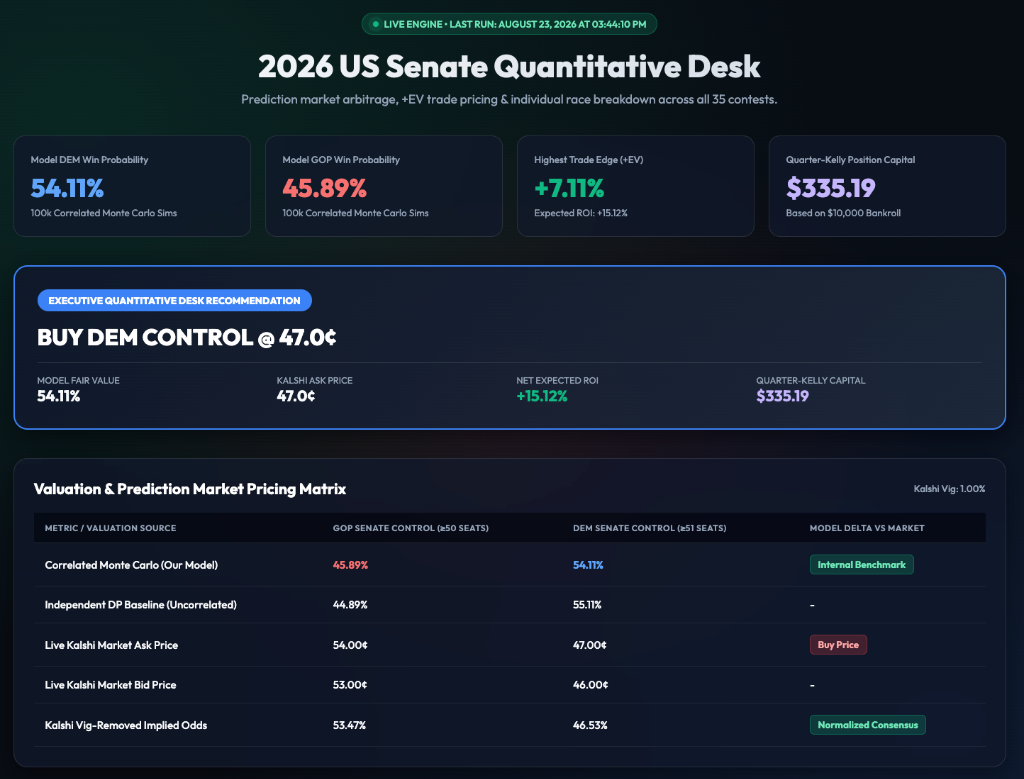
Information asymmetry and informational breakdown has led to potential arbitrage opportunities and pricing mismatch. By scraping market data, comparing implied probabilities based on market supply and demand, and Monte Carlo Simulation, this work can quantify behavioral mismatch. In an example of political elections, comparisons with leading models such as Split Ticket, Quiver Quantitative, Nate Silver's FLIPR, and the Cook Political Report and polling data offers a peek into how real-world events do not follow the adage of "Wisdom of the Crowd."
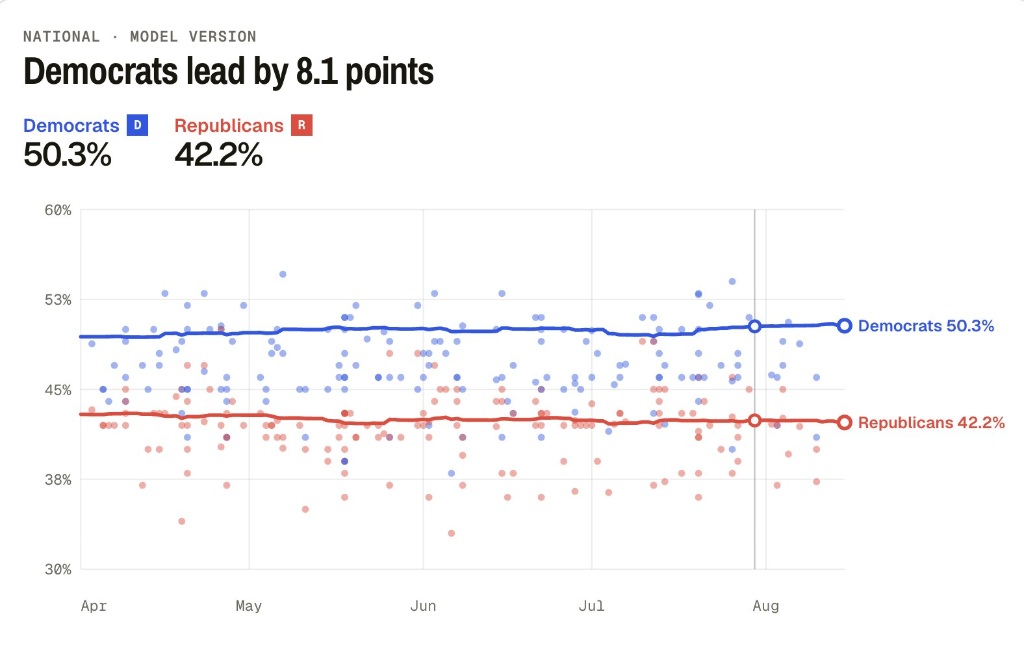
Nate Silver's FLIPR model as of August 15 2026
2026 US Senate Quantitative Desk & Valuation Pricing Matrix

Agentic AI for Qualitative Analysis

AI Agents NLP

Qualitative research methods like semi-structured interviews give clinical researchers rich insight into patient and clinician experience, but analyzing them is slow and labor-intensive. SentinelAI is a model-agnostic, single-agent AI system built to accelerate this process, using Microsoft 365 Copilot to generate a coding framework for each transcript, extract key quotes, and synthesize themes and subthemes into a consolidated table.

We validated SentinelAI against human analysts using interviews from the SENTINEL study, a palliative care intervention for patients undergoing hematopoietic cell transplantation. SentinelAI maintained general consistency with human coding while cutting analysis time by roughly two orders of magnitude, and its highlighted findings aligned with changes later implemented in the study's next phase.

Built on an accessible, non-frontier model, SentinelAI points to a broader opportunity: using LLM agents to close the gap between data collection and clinical implementation across qualitative research.

Single-Cell Electrophysiological Profiling of Cortical Neurons in Glioma Microenvironments

Neuroscience Electrophysiology

Complex neural systems are difficult to replicate for experimental purposes. Recent advances in multielectrode arrays, including high-density probes such as Neuropixels, paired with computational spike-sorting algorithms, now allow researchers to isolate single-neuron activity from population-level electrical recordings. These tools give neuroscientists a window into how populations of neurons communicate to produce complex functions, such as speech, and how those circuits are disrupted when pathological cells, such as glioma cells, are present in the surrounding tissue.

Electrophysiological recordings of neuron-glioma co-cultures represent a new frontier in understanding glioma biology, including emerging evidence that glioma cells can functionally integrate with neuronal circuits. This work may ultimately help inform neurosurgeons' decisions around maximal safe resection.

Poster Presentation:

Cheng A, Daniel A, Hervey-Jumper S. Single-Cell Electrophysiological Profiling of Cortical Neurons in Glioma Microenvironment. UCSF SRTP Symposium 2024

Qualitative Projects

Serious Illness Communication at the End of Life

Serious Illness Communication Hospice & Palliative Care

With colleagues at the San Diego VA, we explore the perspectives of inpatient veterans almost at the end of life, specifically on their thoughts and preferences regarding serious illness communication.

Poster Presentation:

Cheng A ... Albarracin Z. The Language of Illness at the End of Life: A Qualitative Study of “Living while Dying.” UCSD MURALS 2025